Taking a look at the retrofit assessments landscape
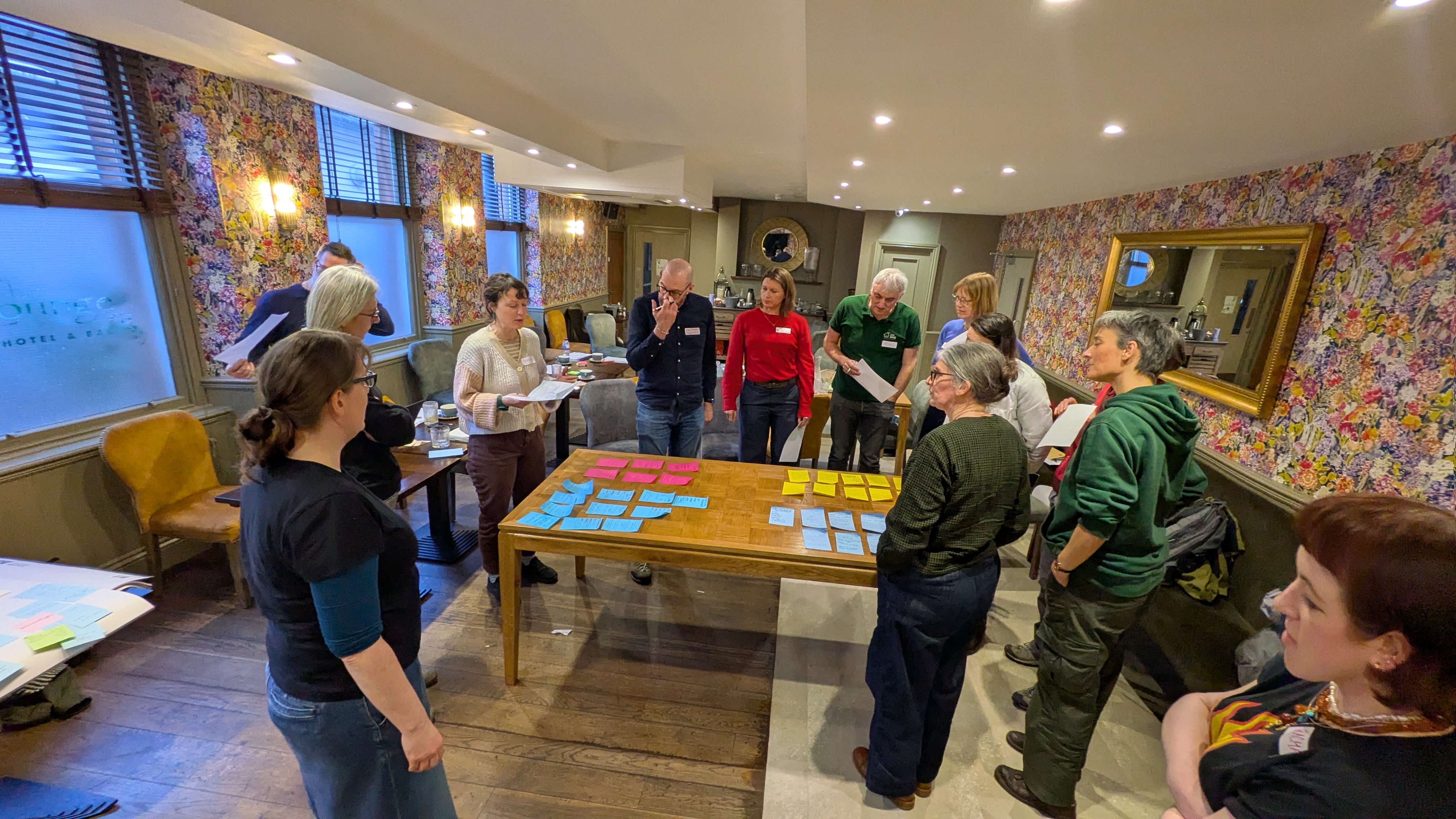




Community of Practice members made the trip up to Cumbria in March for a day of knowledge sharing, learning and discussion on assessments: exploring their purpose within the broader retrofit journey and how the Home Retrofit Planner platform can be used by members of the community.
We were hosted in Penrith by Futureproof Cumbria who have done a great deal of work to explore the potential for detailed assessments to support retrofit. Attending were around 15 assessors and staff members from across the community including People Powered Retrofit, Changeworks, Centre for Sustainability, York Community Energy and Bath and West Community Energy.
The backdrop to the day was the publication last year of the new British Standard BS40104 on retrofit assessments. Whilst PAS2035 has sought to codify a high quality, process-led approach to retrofit projects and clearly outlines a role of assessments within that, it is fairly silent on the detail of how assessments should be carried out and what information should be collected. BS40104 fills that gap including how context, condition, ventilation, occupancy and heritage should be accounted for as well as what kinds of energy models (rdSAP, SAP, PHPP etc) can generate assessments.
Why assessments?
The day began with a group discussion about why we carry out assessments, with reasons identified including to inform householder retrofit decision making, to assist with compliance, to support unbiased, independent advice and to avoid unintended consequences of work that fails to take a holistic view of a home. The discussion also made clear that retrofit assessments are increasingly important in heat pump installations, at sizing systems and offering reassurance to householders on ‘heat pump readiness’.

Different approaches, different outcomes?
The bulk of the session was spent by partners sharing experiences of assessments that their organisation had developed or implemented - reflecting on their purpose, role in the retrofit journey and strengths and weaknesses.
The Home Retrofit Planner assessment is seen by many providers as a gold standard survey, using a modified version of full SAP it is detailed and thorough, generating a full set of retrofit scenarios and supporting the development of a retrofit plan for the householder. The price point for the survey therefore reflects the detail of the assessment and the time that goes into it.
Several other partners had explored different approaches to enable the delivery of assessments at a lower cost. Bath and West Community Energy had developed a lower cost survey, using a proprietary platform driven by rdSAP engine and aiming for a simplified measure recommendation and report. They had also tested a number of surveys developed in collaboration with the Retrofit West one stop shop for the West of England Combined Authority: a heat pump-only measured survey, a damp, mould and ventilation assessment and a draught and ventilation survey.
Marianne Heaslip of People Power Retrofit shared the organisation’s experience of developing simple ‘walk through’ surveys, without a measurement or underlying energy model but instead focusing on building condition and health, and leading to the generation of relatively simple, generic recommendations at low cost.
Futureproof Cumbria shared their fascinating heat pump archetype surveys, a unique approach that emerged out of research conducted for Zero Carbon Cumbria. Based on historic Home Retrofit Planner modelling, Futureproof Cumbria developed energy models for common Cumbrian building archetypes. They then modelled three heat pump scenarios, with low, medium and high fabric intervention and for each, generated data on likely investment costs, bills and carbon savings. These archetypes models have since been used to offer advice to householders via an hour long video call, with a trained surveyor discussing how the archetype in question is similar or different to the householder’s home - and the options open to them for a heat pump installation.
This approach helps overcome a key barrier to a heat pump installation, around 30% of householders think their home is not suitable for a heat pump, or that it will increase their bills [1]. The archetype assessment can give them assurance on what might be involved and the subsequent upfront and bill costs.

Assessment themes
A key point of group reflection on this exercise was the relationship between the time and effort and in turn cost invested in the assessment process versus the quality of the outcome generated. The main observation seemed to be that more effort invested generated higher quality outcomes for the householder and a greater likelihood of action in terms of project progress and works carried out. Assessments requiring lower resource use and time generally raised awareness but less often led to work. Though a counter to this was a question as to whether delivering a lot of low cost assessments might in time lead to more work via raising awareness.
A recurring theme through the discussion was around the basic costs of sending an assessor to a home. Even if that person carried out a relatively basic assessment when they got there, the cost invested in their time and travel equated to a relatively expensive price for the household. The logic runs that if an organisation goes to the cost and expense of sending a person to site, they may as well collect the data needed for a high quality assessment - to avoid repeated visits and costs and offer high quality outcomes.
Remote assessments are less costly, but mean the householder doesn’t benefit from the skill and expertise of a surveyor in their home - spotting elements of the home and condition often overlooked. The use of AI - to carry out assessments and generate reports - was discussed in assisting remote assessments, though in general approaches tested to date within the community were reported to have generated more work for assessors in spotting errors, reviewing outputs, and generally rewriting text.
The Futureproof Cumbria heat pump archetype survey approach was felt to strike a good balance, incorporating detailed assessment and modelling work whilst delivering it via a remote video call. It is relatively low cost and low input - albeit with the need for a skilled and experienced surveyor to run the call and interpret the data. This isn't a full 'retrofit assessment' or condition survey - and unlike some other forms of 'low cost' assessment, is less likely to be taken as such. Advice is based on a similar home, but not their specific home. In this way it is useful to increase householder understanding of the possibilities and things to consider, in a context where they can ask questions. It is also helpful in triage and signposting to other assessments and services - helping people navigate an area that can be confusing and overwhelming to find what's right for them and their home. While at the same time the householder is less likely to take false reassurance from something that is not a full survey.
A final reflection related to the challenge of accurately understanding current market dynamics in the world of retrofit assessments due to so many local authorities and grant funded initiatives having subsidised the cost of assessments, with very few on the market currently reflecting the actual cost of delivery and pricing the assessment accordingly. Market making work and householder subsidies offered by Retrofit West in particular has generated a lot of demand for assessments in the West of England area, though it’s unclear where price points will eventually end up.

Next steps
Moving forward, this session constituted the kick off of a Community of Practice theme dedicated to assessments. Reflecting on the day, members decided to explore four areas of theme going forward: continuing to map the landscape for assessments, exploring the potential for lower cost assessments, developing and testing new features and applications of Home Retrofit Planner and reflecting on the implementation of the Warm Homes Plan agenda and assessments within this. We’re looking forward to a meet up in Bath in September to reflect on progress against these.
We want to say a huge thanks to Amy, Tina and Zoe from Futureproof Cumbria for hosting the session and we’re looking forward to working with the Community of Practice to further explore this theme and expect to continue to share results and learning publicly.
References
[1] Identifying barriers to air source heat pump adoption, A Nesta research project (2026)
https://www.nesta.org.uk/report/identifying-barriers-to-air-source-heat-pump-adoption/